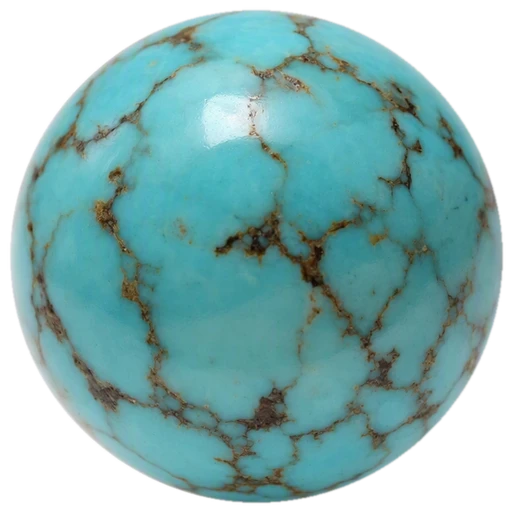
Turquoise
Going a long way and arriving whole.
What the tradition reads it as
Mined in Sinai, in Persia, and independently across the American Southwest, and in every one of those places it travelled with people — sewn onto saddles and set into bridles centuries before it was set into rings. The through-line is the journey.
When people wear it
Worn on the day you leave, and on the days that feel like being in transit whether or not you have gone anywhere.
What you are actually holding
A copper aluminium phosphate that is naturally porous and chalky. Nearly everything on the market is stabilised with resin so it can be cut at all; ours is stabilised and disclosed. Dark veining is the host rock it grew against.
How to look after it
Soft at 5 Mohs and porous even when stabilised: perfume, sunscreen, sanitiser, and body oil all discolour it over months. Put it on last, and wipe it with a dry cloth only.
Turquoise was mined at Serabit el-Khadim in Sinai, in Persia, and independently across the American Southwest, and in all of those places it travelled with people — set into bridles and sewn onto saddles long before it was set into rings. Nearly all turquoise on the market is stabilised with resin so it can be cut without crumbling; ours is stabilised and disclosed. The dark veining is the host rock.
In a reading
The traveller's stone, sewn onto saddles before rings.
Crystal meanings are described as cultural tradition, not fact. Stones and readings are offered for reflection, not as medical, financial, or legal advice.